

Clinical Cleaning & Healthcare
Clinical Cleaning for Veterinary Practices & Hospitals
For small animal practices and veterinary hospitals across Kent and London.
A veterinary practice runs consultations, surgery, dentistry, imaging, kennelling and isolation under one roof, often around the clock. Each area needs its own cleaning standard, and that standard has to be defined, carried out and recorded, not left to whoever has a spare moment between cases.
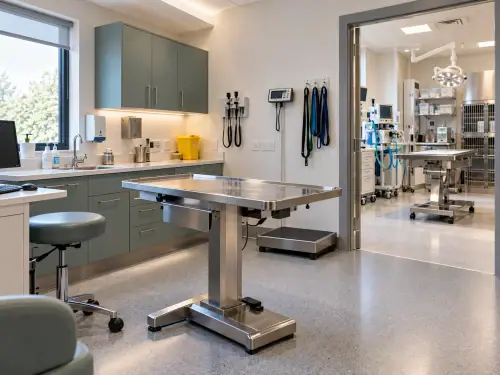
Could this be happening in your practice?
Why cleaning slips when the practice is busy.
Cleaning in most practices falls to your nurses and animal care assistants, fitted in between consults, operations and in-patient care. On a busy day the table gets wiped, but the deeper work waits: kennel fronts, drains, isolation, the prep room and the corners of theatre. Where there is a contract cleaner, they often cover only reception and offices and have never been briefed on clinical areas.
Ask yourself:
- Does your cleaning schedule set a different standard for consult rooms, theatre, kennels and isolation?
- When an infectious case leaves isolation, who carries out the deep clean, and how long does it take your nurses away from patients?
- Are the contact times on your disinfectant labels followed, or cut short when the next case is waiting?
- If a Practice Standards assessor asked for your cleaning records tomorrow, would they be complete?
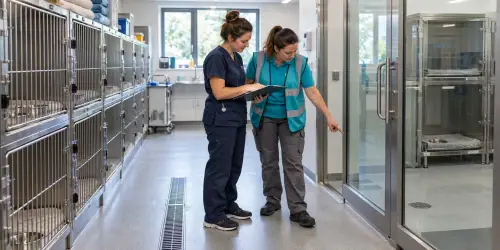
Where responsibility falls between teams
Your team may not be the problem.
The system around them may need strengthening. In veterinary practices, the gaps usually sit in the same places:
- Isolation kennels, which need a full deep clean after each infectious case and are often cleaned at the end of a long shift
- Kennels, runs and cat wards, where hair, bedding, food and body fluids build up in fixings, drains and hinges that daily cleaning does not reach
- Theatre and prep areas, where the clinical team cleans between cases but the periodic deep clean has no clear owner
- Dental rooms, where aerosols from scaling and polishing settle on surfaces well beyond the table
- Waiting areas, reception floors and weigh scales, used by dogs, cats and their owners all day
- Out-of-hours and 24-hour hospital areas, where rooms are rarely empty long enough to be cleaned properly
You gain a written specification stating who cleans what between cases, at the end of each day and on a planned deep-clean cycle.
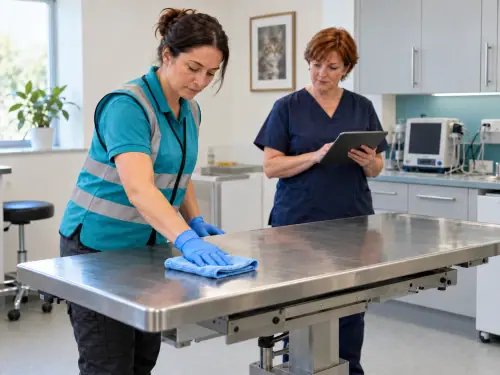
Protecting your patients, your team and your equipment
Animals change how a room can be cleaned.
Veterinary cleaning has constraints a human clinic does not. Animals in kennels cannot always be moved, birds and other small species are particularly sensitive to airborne chemicals, and product residue on floors and kennel surfaces can end up on paws and fur. Your specification states which products are used in each area, the dilution and contact time for each, and when animals can return to a cleaned space.
Imaging, anaesthetic and dental equipment is costly to repair. Manufacturers specify which products can be used on equipment surfaces, and your specification follows those instructions. Instruments, anaesthetic circuits, endotracheal tubes and anything that goes through your sterilisation process stay with your clinical team under their own protocols.
When the risk justifies more, such as after an infectious case has left isolation, you have an agreed and documented enhanced step available. One option is automated dry fogging with hypochlorous acid (HOCl), a biocide used for environmental disinfection. It supports physical cleaning and disinfection rather than replacing them. Fogging takes place only in a room cleared of animals and people, and suitability, room downtime and compatibility with your equipment are agreed with you in advance.
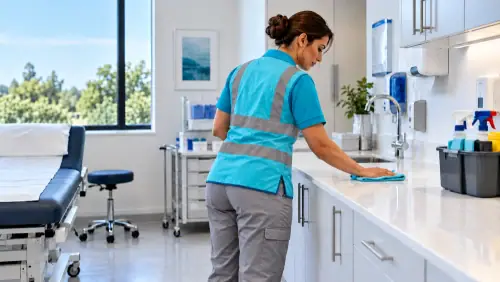
The Aridom approach
Clean → Disinfect → Enhance where required → Verify → Document
Every area is assessed before a specification is written, because a consult room, a kennel ward and an isolation unit do not need the same response.
- Clean. Physical removal of soil and organic matter from every agreed surface, using the right method and colour-coded equipment for each area.
- Disinfect. An appropriate disinfectant, applied at the correct concentration and contact time for the surfaces and risk involved.
- Enhance where required. Enhanced environmental decontamination for defined situations, agreed with you in advance rather than applied by default.
- Verify. Each visit is checked against the agreed specification, using products selected with reference to recognised BS EN efficacy standards for their intended use and, where agreed, further verification suited to your setting.
- Document. A record of what was done, where, when and by whom, including any issues found and the action taken.
You gain a specification that matches each area and a clear line from risk, to action, to evidence.
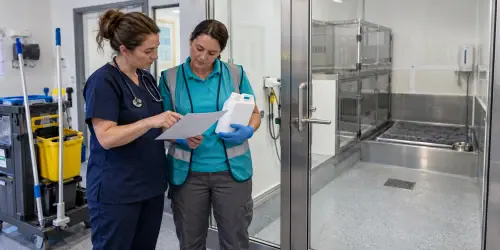
Verification, documented assurance and contingency
Evidence you can produce, and a plan for when things change
You receive a clear record for every agreed visit: the areas covered, the tasks completed, who carried them out, the products used, and any issues found with the action taken. Safety data sheets and efficacy test information for those products are available on request. The record supports your own audits and, where your practice is accredited under the RCVS Practice Standards Scheme, your assessment preparation; it does not replace them.
Contingency is planned before it is needed:
- Cover arrangements for absence and short-notice changes are agreed at the outset, so your consulting and operating lists are protected
- A defined route for requesting an enhanced response after a contamination event, with response times agreed with you
- Clear communication with your practice manager or head nurse on what was done and when each room is ready to use again
You know what happens next, before you need it.
Common questions
Clinical cleaning for veterinary practices and hospitals
Do you clean instruments and anaesthetic equipment?
No. Instruments, anaesthetic circuits, endotracheal tubes and anything that goes through your sterilisation process stay with your clinical team under their own protocols. Your specification covers rooms, kennels, fixed surfaces and the outer surfaces of equipment where the manufacturer’s instructions allow, as agreed with you.
What happens after an infectious case leaves isolation?
The isolation area is deep cleaned to an agreed protocol, with PPE and equipment kept to that area. Products are chosen with your clinical team for the organisms of concern, and where Aridom Sanex product data does not cover a specific organism, your practice’s own approved disinfectant is used for that step. Your vets decide when the area returns to use.
Can you come out at short notice?
Urgent call-outs can be arranged for specific situations: turning an isolation area around after an infectious case, or cleaning up a significant blood or body fluid spill in a public or clinical area. Each is quoted as a call-out, with the charge and timing confirmed with you before work starts, and timing depends on your location.
Is the process safe for the animals in our care?
Products, dilutions and contact times are set out for each area, and animals return to a cleaned space only once surfaces are dry and the agreed time has passed. Automated fogging is carried out only in a room cleared of animals and people, and re-entry follows the time agreed with you in advance.
We are accredited under the RCVS Practice Standards Scheme. How does this fit?
The specification is written around the areas in your practice and the level you are accredited at. The cleaning records support your own audits and assessment preparation; they do not replace your responsibilities under the scheme.
We are part of a group. Can one specification cover several practices?
Yes. One specification can set the same standard across every site, with records kept for each. Where your group already specifies a disinfectant, the specification can be built around it.
Can cleaning fit around consults, surgery and in-patients?
Visits are agreed around your consulting hours, operating lists and in-patient care before work starts, including early morning, evening or weekend visits. In 24-hour hospitals, areas are cleaned in an agreed sequence so patients can be moved safely.
Which areas do you cover?
Veterinary practices and hospitals across Kent, including Maidstone, Tunbridge Wells, Tonbridge, Medway, Sevenoaks, Canterbury, Ashford and Dartford, and across London, including Bromley and central and south-east London.

Request an Environmental Hygiene & Clinical Cleaning Review
Tell us about your practice and we will arrange a review of your current cleaning arrangements: consult rooms, theatre, kennels and isolation, who cleans what between cases, and the products and records in place today. You receive a clear summary of any gaps and practical options for closing them, with no commitment to proceed.
Maidstone Innovation Centre, Gidds Pond Way, Kent Medical Campus, Maidstone, Kent ME14 5FY