
Clinical Cleaning & Healthcare
Clinical Cleaning for Private, Diagnostic & Specialist Clinics
For private medical and diagnostic clinics across Kent and London
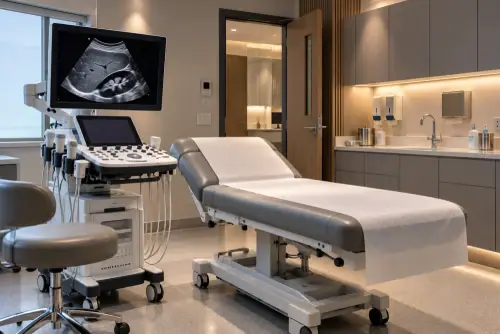
In a clinic that combines consultations, diagnostics and minor procedures, one cleaning routine rarely fits every room. The standard that a scanning room, a procedure room and a waiting area each need has to be defined, carried out and recorded, not assumed.
Could this be happening in your clinic?
Why an office cleaning contract does not fit a clinic
Your patients may move from reception to a consultation, a blood test, a scan or a minor procedure within a single visit, and each of those rooms carries a different risk. Consultants use the same rooms on different days, diagnostic lists run late, and the cleaning contract was often written for offices and applied to clinical space. Specialist equipment areas end up avoided, or cleaned with products the manufacturer never approved.
Ask yourself:
- Does your cleaning specification distinguish a consultation room from a procedure room?
- Who resets a room when one consultant’s session ends and the next begins?
- Are the products used around your imaging equipment ones the manufacturer permits?
- Could you show what was cleaned, when and by whom if you were asked tomorrow?
Where responsibility falls between teams
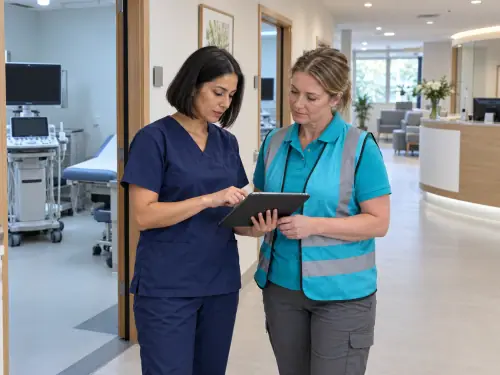
Your cleaning team may not be the problem
The system around them may need strengthening. In private and diagnostic clinics, the gaps usually sit in the same places:
- Consulting rooms used by different consultants across the week, where nobody owns the reset between sessions
- Scanner tables, couches and equipment surfaces that clinical staff wipe between patients, and the surrounding areas nobody is asked to clean
- Phlebotomy chairs and minor-procedure rooms, where blood and body fluid spills need a defined response beyond routine cleaning
- Waiting areas, reception and washrooms serving high patient numbers across long clinic days
- Evening and weekend lists that finish after the cleaning visit has already happened
You gain a written specification stating who cleans what between patients, between sessions and at the end of each clinic day.
Protecting your equipment and your diagnostic areas
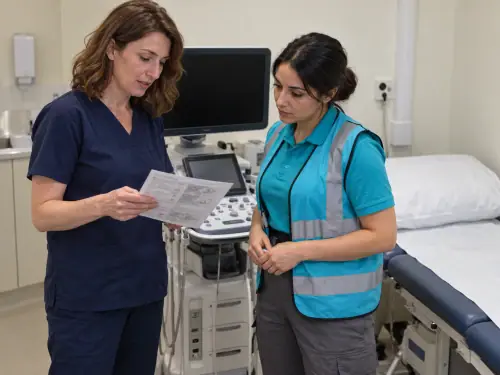
Specialist rooms need their own rules
Imaging and diagnostic equipment is expensive to repair and costly to take out of service. Manufacturers specify which products can be used on equipment covers, patient tables, control panels and screens, and your specification follows those instructions. Between-patient decontamination of probes, patient-contact accessories and single-use items stays with your clinical team under their own protocols.
Some rooms carry their own rules. In MRI, nothing ferromagnetic can enter the scanner room, so cleaning there follows your MR safety procedures, uses only equipment suitable for the MR environment, and does not include automated fogging. In X-ray and CT, access to controlled areas follows the local rules set by your radiation protection arrangements. Cleaning works within those rules, not around them.
When the risk justifies more, such as after a contamination event in a procedure room, you have an agreed and documented enhanced step available. One option is automated dry fogging with hypochlorous acid (HOCl), a biocide used for environmental disinfection. It supports physical cleaning and disinfection rather than replacing them, and suitability, room downtime and compatibility with your equipment are agreed with you in advance.
The Aridom approach
Clean → Disinfect → Enhance where required → Verify → Document
Every room is assessed before a specification is written, because a consultation room, a phlebotomy room and an imaging suite do not need the same response.
- Clean. Physical removal of soil and organic matter from every agreed surface, using the right method and colour-coded equipment for each area.
- Disinfect. An appropriate disinfectant, applied at the correct concentration and contact time for the surfaces and risk involved.
- Enhance where required. Enhanced environmental decontamination for defined situations, agreed with you in advance rather than applied by default.
- Verify. Each visit is checked against the agreed specification, using products selected with reference to recognised BS EN efficacy standards for their intended use and, where agreed, further verification suited to your setting.
- Document. A record of what was done, where, when and by whom, including any issues found and the action taken.
You gain a specification that matches each room and a clear line from risk, to action, to evidence.

Verification, documented assurance and contingency
Evidence you can produce, and a plan for when things change
You receive a clear record for every agreed visit: the areas covered, the tasks completed, who carried them out, the products used, and any issues found with the action taken. Safety data sheets and efficacy test information for those products are available on request. The record supports your own audits and, where your clinic is regulated, your inspection preparation; it does not replace them.
Contingency is planned before it is needed:
- Cover arrangements for absence and short-notice changes are agreed at the outset, so your clinic lists are protected
- A defined route for requesting an enhanced response after a contamination event, with response times agreed with you
- Clear communication with your practice manager or clinic lead on what was done and when each room is ready to use again
You know what happens next, before you need it.

Common questions
Clinical cleaning for private, diagnostic and specialist clinics
Do you clean scanners, probes and other clinical equipment?
Between-patient decontamination of probes, patient-contact accessories and single-use items stays with your clinical team under their own protocols. Your specification covers the rooms, fixed surfaces and the outer surfaces of equipment where the manufacturer’s instructions allow, as agreed with you.
Can you clean MRI areas?
Cleaning in MRI areas is agreed with your MR safety lead before any work starts. Access follows your MR safety procedures, only equipment suitable for the MR environment enters the scanner room, and automated fogging is not used there.
We are CQC-registered. How does this fit with our inspection?
The specification is written around the services you provide and the rooms you use. The records support your own audits and inspection preparation; they do not replace your responsibilities as the registered provider.
Can one specification cover rooms let to several consultants, or several sites?
Yes. If you manage consulting rooms let by the session or run more than one site, one specification can set the same reset standard for every room and every user, with records kept for each site.
Do you work with Community Diagnostic Centres?
Community Diagnostic Centres are often run by independent operators on behalf of the NHS, and cleaning usually sits with the operator or the host site’s facilities provider. If you are responsible for environmental hygiene at a centre, the same room-by-room approach applies, and specialist or enhanced work can be scoped separately.
Can cleaning fit around clinic lists?
Visits are agreed around your clinic lists and opening hours before work starts, including early morning, evening or weekend visits, so your lists are not disrupted.
Which areas do you cover?
Private, diagnostic and specialist clinics across Kent, including Maidstone, Tunbridge Wells, Tonbridge, Medway, Sevenoaks, Canterbury, Ashford and Dartford, and across London, including Bromley and central and south-east London.

Request a Clinical Cleaning Review
Tell us about your clinic and we will arrange a review of your current cleaning arrangements: the rooms and equipment areas, responsibilities between sessions, products and records in place today. You receive a clear summary of any gaps and practical options for closing them, with no commitment to proceed.
Maidstone Innovation Centre, Gidds Pond Way, Kent Medical Campus, Maidstone, Kent ME14 5FY