

Clinical Cleaning & Healthcare
Clinical Cleaning & Environmental Hygiene for IVF & Fertility Clinics
For fertility clinics across Kent and London
In fertility care, environmental hygiene has to work around both patients and highly sensitive clinical and laboratory processes. Waiting areas, consultation rooms, treatment spaces, washrooms and shared areas create different requirements from embryology laboratories and cryostorage. One cleaning approach should not simply be applied everywhere.
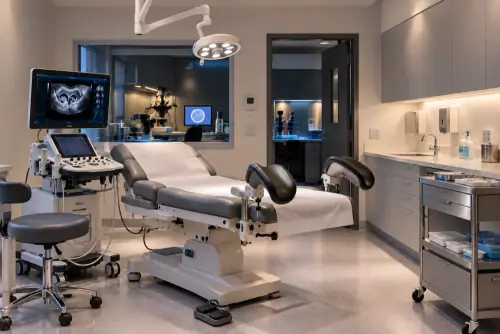
Could this be happening in your clinic?
Why fertility clinics need more than a standard cleaning contract
Your clinic runs to tight treatment cycles, with egg collections, transfers and scans booked around patients who are often anxious and highly observant. Cleaning contractors change, laboratory staff clean their own spaces, and nobody is quite sure who owns the areas in between. A product introduced for convenience in one room can find its way into another where it was never assessed.
Ask yourself:
- Are cleaning responsibilities clearly separated between patient areas, treatment rooms and specialist laboratory environments?
- Can you demonstrate which products and processes are approved for each area?
- What happens when routine cleaning is no longer sufficient?
- How are changes to products or enhanced decontamination methods assessed before use around sensitive embryology environments?

Zones, not one cleaning routine
Where responsibility falls between teams
Your cleaning team may not be the problem. The system around them may need strengthening. In fertility clinics, the gaps usually sit at the boundaries:
- Reception, waiting areas and patient toilets, where patients form their first impression
- Consultation, scanning and treatment rooms, including rooms used for egg collection and transfer
- Laboratory thresholds, changing areas and airlocks, where cleaning and embryology responsibilities meet
- Cryostorage, where liquid nitrogen safety and restricted access change how and by whom cleaning is done
- The embryology laboratory itself, which follows the laboratory’s own validated protocols
You gain a zoned specification stating what is cleaned, how, with which approved products and by whom, in every area.
.webp)
Product control around the laboratory
Why what you clean with matters as much as how
Embryology laboratories are sensitive to volatile organic compounds (VOCs) and residues, which is why many clinics restrict the products allowed near or inside them. We work to your laboratory’s approved products and methods, not ours. Any proposed change, whether a new product or an enhanced decontamination method, is assessed with your laboratory team first, covering compatibility, residues, materials, equipment and workflow.
Enhanced environmental decontamination, including automated dry fogging with hypochlorous acid (HOCl), a biocide used for environmental disinfection, is only considered for agreed patient-facing and general clinical areas. It is never proposed around embryos, incubators, the embryology laboratory, cryostorage or laboratory air handling unless that exact application has been appropriately validated.
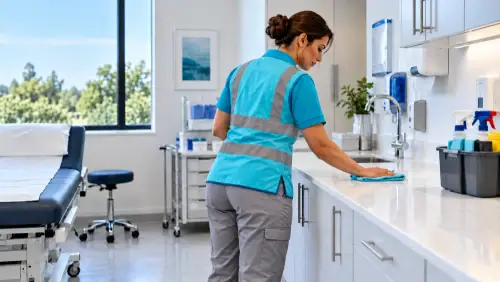
The Aridom approach
Clean → Disinfect → Enhance where required → Verify → Document
Every zone of your clinic is assessed before a specification is written, and the work is led by a founder with an MSc in Clinical Embryology who understands the procedures your team works to.
- Clean. Physical removal of soil and organic matter from every agreed surface, using the right method and colour-coded equipment for each zone.
- Disinfect. An appropriate disinfectant, applied at the correct concentration and contact time for the surfaces and risk involved.
- Enhance where required. Enhanced environmental decontamination in agreed patient-facing and clinical areas only, never by default and never in the laboratory without validation.
- Verify. Each visit is checked against the agreed specification, using products selected with reference to recognised BS EN efficacy standards for their intended use and, where agreed, further verification suited to your setting.
- Document. A record of what was done, where, when and by whom, including any issues found and the action taken.
You gain a specification that respects your laboratory’s controls and a clear line from risk, to action, to evidence.

Verification, documented assurance and contingency
Evidence you can produce, and a plan for when things change
You receive a clear record for every agreed visit: the zones covered, the tasks completed, who carried them out, the products used, and any issues found with the action taken. Safety data sheets and efficacy test information for those products are available on request. The record supports your own quality management system and your preparation for HFEA and CQC inspection; it does not replace them.
Contingency is planned before it is needed:
- Cover arrangements for absence and short-notice changes are agreed at the outset, so treatment schedules are protected
- A defined route for requesting an enhanced response in patient-facing areas, with response times agreed with you
- Clear communication with your quality manager or laboratory lead on what was done and when each area is ready to use again
You know what happens next, before you need it.

Common questions
Clinical cleaning for IVF and fertility clinics
Do you clean inside the embryology laboratory?
Only where your laboratory team asks us to, and only to its own protocols and approved products. Many clinics keep laboratory cleaning in-house; we agree the boundary with you so nothing falls between the two.
Will you use fogging near incubators or embryos?
No. Enhanced methods are only considered for agreed patient-facing and general clinical areas, never around embryos, incubators, the laboratory, cryostorage or laboratory air handling unless that exact application has been validated.
How does this support HFEA and CQC inspection?
UK fertility clinics are licensed and inspected by the HFEA and, in England, also registered with and inspected by the CQC. Our records show what was cleaned, how, with which products and by whom, supporting your own evidence for both. Compliance remains the clinic’s responsibility.
Who leads the work?
Aridom Sanex’s founder, who holds an MSc in Clinical Embryology and understands the procedures and sensitivities of fertility clinics.
Which areas do you cover?
Fertility clinics across Kent, including Maidstone, Tunbridge Wells, Tonbridge, Medway, Sevenoaks, Canterbury, Ashford and Dartford, and across London, including Bromley and central and south-east London.

Request a Clinical Cleaning Review
Tell us about your clinic and we will arrange a review of your current cleaning arrangements: the zones, responsibilities, approved products and records in place today. You receive a clear summary of any gaps and practical options for closing them, with no commitment to proceed.
Maidstone Innovation Centre, Gidds Pond Way, Kent Medical Campus, Maidstone, Kent ME14 5FY