
Clinical Cleaning & Healthcare
Clinical Cleaning & Environmental Decontamination for Hospitals & Day Surgery
For hospitals and day-surgery units across Kent and London
When different teams, spaces and responsibilities come together, keeping environmental hygiene consistent becomes an operational challenge as much as a cleaning task.
The question is not simply whether a room has been cleaned. It is whether the right process was completed, by the right person, at the right time, and whether you can demonstrate it.
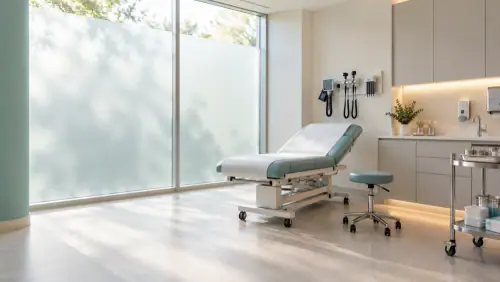
Could this be happening in your facility?
Why clinical cleaning is more complex than it first appears
In a hospital or day-surgery unit, the same corridor, procedure room or recovery bay may be used by clinical staff, domestic teams, porters and contractors in a single shift. Lists overrun, rooms are needed back quickly and a spill or contamination event can land at the worst moment. Cleaning happens, but who owns each task, and who checks it, is often less clear.
Ask yourself:
- How confident are you that cleaning responsibilities are clearly defined across clinical and non-clinical areas?
- What happens when patient turnover, staff absence or an unexpected contamination event disrupts the normal schedule?
- Can you demonstrate what was cleaned, when it was completed and what action was taken when an enhanced response was needed?
If any of these give you pause, the gap is rarely effort. It is usually the system around the people doing the work.
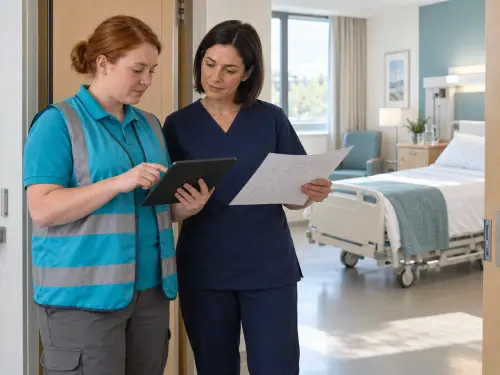
Your cleaning team may not be the problem
The system around them may need strengthening
When something is missed, the instinct is to look at the person holding the cloth. More often, the gap sits in the system: a specification that no longer matches how the unit runs, tasks that were never assigned, or handovers that rely on memory.
In hospitals and day-surgery units, responsibility most often falls between teams in the same places:
- Bedside and trolley equipment, where clinical and domestic duties meet
- Procedure rooms between cases, compared with the end of a list
- Spills and body-fluid contamination outside normal cleaning rounds
- Shared areas used by several departments, such as corridors, sluices and store rooms
- Out-of-hours periods, when cover arrangements change
You gain a clear map of who owns each of these, so gaps are closed by design rather than discovered at audit.
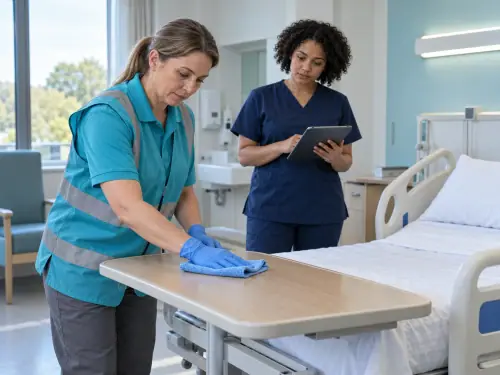
Cleaning, disinfection and enhanced decontamination are not the same thing
Each has a job, and the right one depends on the risk
Cleaning physically removes dirt, organic matter and many microorganisms from surfaces. It is the foundation for everything else, because disinfectants work poorly on surfaces that have not been cleaned first.
Disinfection uses an appropriate product, at the right concentration and contact time, to reduce the microorganisms that remain on a cleaned surface.
Enhanced environmental decontamination is an additional step for defined situations, such as after an outbreak, a contamination event or a higher-risk case before a room returns to use. Automated methods can reach areas that manual cleaning does not easily reach, but they support physical cleaning rather than replacing it.
Where enhanced decontamination is justified, the method is chosen for the risk, the room and the equipment in it. One option is automated dry fogging with hypochlorous acid (HOCl), a biocide used for environmental disinfection. Suitability, contact time, room downtime and compatibility with materials are agreed in advance, never assumed.
You know which level of response each situation needs, and why.
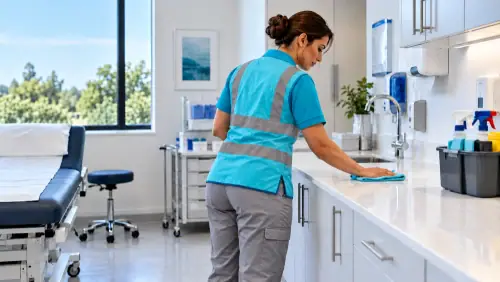
The Aridom approach
Clean → Disinfect → Enhance where required → Verify → Document
Every area of your unit is assessed before a specification is written, because a recovery bay, a procedure room and a staff corridor do not need the same response.
- Clean. Physical removal of soil and organic matter from every agreed surface, using the right method and colour-coded equipment for each area.
- Disinfect. An appropriate disinfectant, applied at the correct concentration and contact time for the surfaces and risk involved.
- Enhance where required. Enhanced environmental decontamination for defined situations, agreed with you in advance rather than applied by default.
- Verify. Each visit is checked against the agreed specification, using products selected with reference to recognised BS EN efficacy standards for their intended use and, where agreed, further verification suited to your setting.
- Document. A record of what was done, where, when and by whom, including any issues found and the action taken.
You gain a specification that matches each space and a clear line from risk, to action, to evidence.
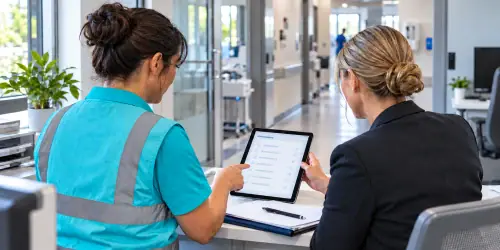
Verification, documented assurance and contingency
Evidence you can produce, and a plan for when things change
You receive a clear record for every agreed visit: the areas covered, the tasks completed, who carried them out, and any issues found with the action taken. The record also lists the products used, with safety data sheets and efficacy test information available on request. It supports your own audits, inspections and quality reviews; it does not replace them.
Contingency is planned before it is needed:
- Cover arrangements for absence and short-notice changes are agreed at the outset
- A defined route for requesting an enhanced response after a contamination event or outbreak, with response times agreed with you
- Clear communication with your infection prevention and control lead on what was done and when the area is ready to use again
You know what happens next, before you need it.
Common questions
Clinical cleaning for hospitals and day-surgery units
How is clinical cleaning different from general commercial cleaning?
It is built around clinical risk rather than appearance. Specifications reflect how each area is used, products and contact times are chosen for healthcare surfaces, responsibilities are defined between clinical and cleaning staff, and completion is recorded.
Does fogging replace manual cleaning?
No. Physical cleaning and disinfection remain the foundation. Enhanced decontamination, such as automated dry fogging with hypochlorous acid, is an additional step for defined situations.
Can cleaning be scheduled around procedure lists?
Schedules are agreed around your lists, turnaround times and access arrangements before work starts, including out-of-hours visits where required.
What records will we receive?
A record of each visit showing areas covered, tasks completed, who carried them out, issues found and the action taken, plus verification results where agreed.
Which areas do you cover?
Hospitals and day-surgery units across Kent, including Maidstone, Tunbridge Wells, Tonbridge, Medway, Sevenoaks, Canterbury, Ashford and Dartford, and across London, including Bromley and central and south-east London.

Request a Clinical Cleaning Review
Tell us about your unit and we will arrange a review of your current cleaning arrangements: the areas, responsibilities, products and records in place today. You receive a clear summary of any gaps and practical options for closing them, with no commitment to proceed.
Maidstone Innovation Centre, Gidds Pond Way, Kent Medical Campus, Maidstone, Kent ME14 5FY