

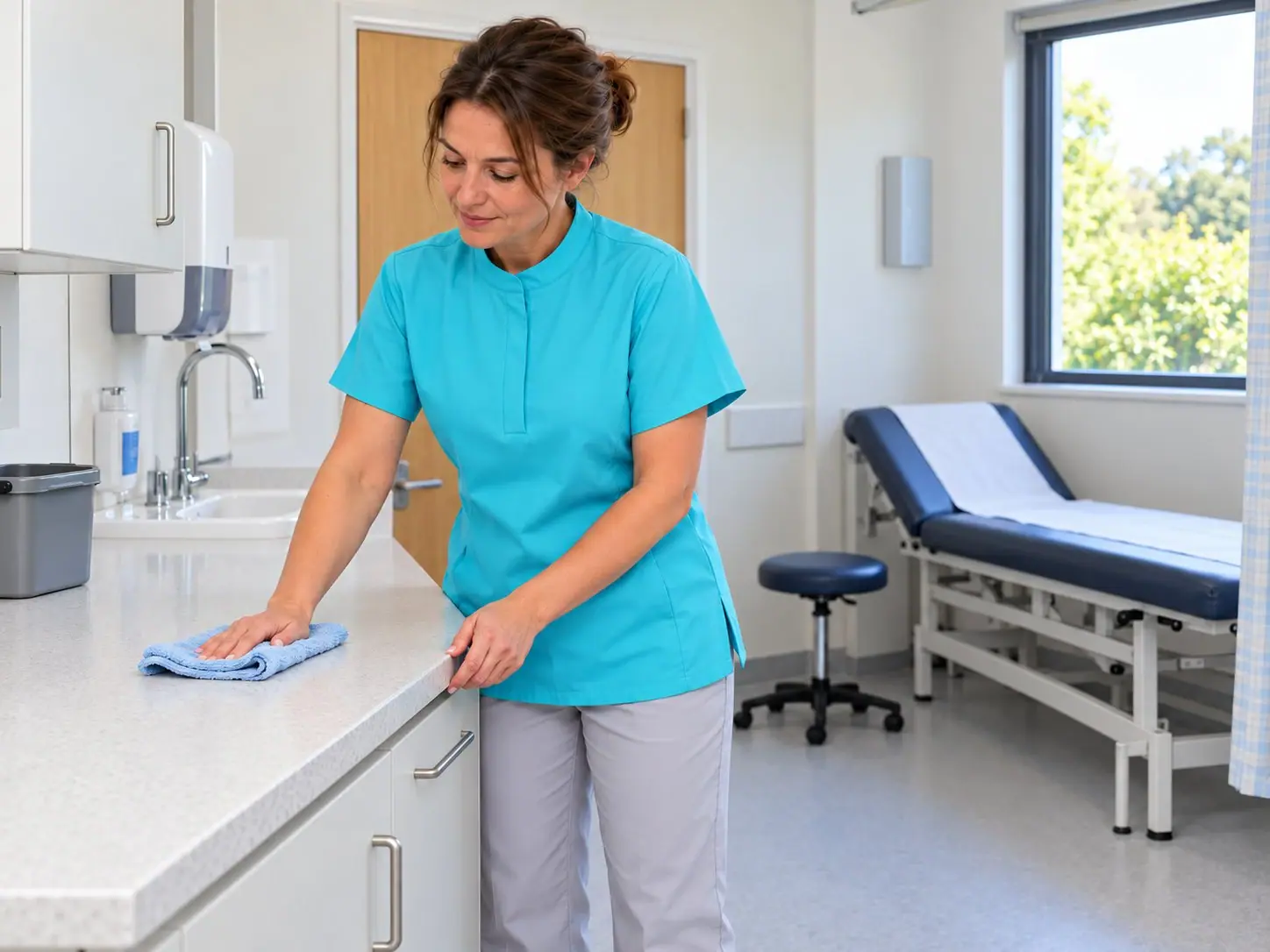
A clinic can look clean without having a clearly managed cleaning programme. For a practice, clinic or care manager, the more useful question is whether cleaning arrangements reflect what happens in each room, who is responsible for the work and how the organisation knows it has been done.
This guide is for managers comparing providers or reviewing an existing contract in GP, dental, aesthetic, fertility, diagnostic, veterinary and care settings. It explains what to ask, how science informs cleaning decisions and why two quotations offering similar hours may describe very different services. For a discussion about your site, contact Aridom Sanex.
Three Things to Check Before Appointing a Cleaner
- Define the workMatch the specification to each room, surface and responsibility.
- Verify the evidenceKnow what training, records and audits can and cannot show.
- Compare the quotationUse the same written requirements for every provider.
On this page
What does a clinical environment need from cleaning?
A clinical environment needs a cleaning specification matched to the activities, surfaces and contamination risks in each area.
An office, reception desk, consultation room and treatment room do not necessarily need the same cleaning methods or frequencies. A useful specification identifies the surfaces covered, high-touch points, cleaning frequency, appropriate methods, exclusions and responsibility for clinical equipment.
It should also say who checks completion and what happens when a task cannot be carried out. These details matter whether the cleaner is employed directly or contracted externally.
Different areas within a healthcare practice have different cleaning requirements. Administrative offices and reception areas may be suitable for routine cleaning, while consultation rooms, treatment areas and other clinical spaces require cleaning procedures appropriate to their use and associated infection risks. Clinical cleaning is not about using specialist products everywhere. It is about understanding the environment and applying the right cleaning procedures in the right areas.
Where does the specification differ by area?
Cleaning decisions should follow how each area is used, not a single schedule applied to the whole building.
There is no standard frequency that suits every site. Frequencies and methods depend on use, risk and the organisation’s own infection prevention and control (IPC) policy. The table shows what to think about, area by area.
| Area | What to think about |
|---|---|
| Reception and waiting areas | High-touch points such as door handles, desks, seating arms and card machines; how busy the area is; what is cleaned during the day and what out of hours. |
| Consultation rooms | Which surfaces the contractor cleans and which the clinical team cleans between patients; responsibility for couches, chairs and equipment. |
| Treatment and procedure rooms | The room’s IPC requirements; between-patient cleaning compared with scheduled cleaning; who is competent to clean which items. |
| Toilets and washrooms | How often they are checked in relation to use; who restocks supplies; what is recorded. |
| Clinical sinks and utility rooms | Who is responsible, which equipment is used, and whether it is kept separate from other areas. |
| Staff areas and offices | General cleaning is usually suitable; confirm that it is specified separately from clinical areas. |
| Specialist areas | Laboratories, procedure suites, fertility or veterinary treatment areas and care home bedrooms need a written, area-specific specification agreed with your IPC lead. Do not assume a general schedule applies. |
Routine cleaning and periodic deep cleaning
Routine cleaning delivers the agreed tasks on a regular schedule. Periodic deep cleaning is a planned, more intensive clean of surfaces and areas that routine visits do not reach. One does not replace the other, so a specification should say which is included, how often deep cleans are planned and who confirms they are complete.
What is not included
Clinical waste and sharps are normally handled under separate arrangements with their own legal requirements, so a specification should say plainly whether they are included. Do not assume they are. Instrument decontamination is likewise outside routine environmental cleaning unless it has been specifically contracted to a competent provider.
Can a room look clean without being appropriately cleaned?

Yes. Visual cleanliness matters, but appearance alone cannot confirm that agreed cleaning procedures have been followed or that a surface has been disinfected appropriately.
Cleaning removes dirt and contamination through physical action. Disinfection, where indicated, is an additional process intended to inactivate specified microorganisms. Selection and use of a disinfectant depend on its authorised purpose, the surface, product instructions, appropriate contact time and relevant safety controls.
No one product or technology makes a cleaning programme complete. The starting point is understanding what contamination may occur and selecting a method appropriate to the task. That is what a science-informed approach should mean in everyday practice.
What is the difference between attendance-led and specification-led cleaning?
The important difference is what a provider agrees to deliver and demonstrate, rather than whether it describes itself as a general or specialist cleaning company.
| Compare | Attendance-led quotation may specify | Specification-led quotation should clarify |
|---|---|---|
| Scope | Rooms and hours | Rooms, surfaces, high-touch points and exclusions |
| Method | General tasks | Site-approved methods and task frequencies |
| Records | Attendance or basic checklist | Completion records linked to agreed tasks |
| Checking | Informal spot checks | Named responsibility and scheduled inspections |
| People | General induction | Task-specific training and competence checks |
| Products | Routine cleaning supplies | Approved products, instructions and compatibility |
| Incidents | Contact for complaints | Escalation and corrective-action process |
| Reporting | Updates on request | Agreed reporting to management or the IPC lead |
These are illustrative quotation formats, not labels for good and bad contractors. Any competent provider may be able to offer a specification-led service.
What happens when cleaning arrangements are not clearly defined?
Usually nothing dramatic at first. Gaps tend to show up later, when someone asks who was responsible and the answer is not written down.
| Situation | What can happen | What to agree | What you should expect to see |
|---|---|---|---|
| Nobody is clearly responsible for cleaning the treatment couch | Clinical staff and the cleaner may each assume the other has done it, so it may be cleaned inconsistently between patients. | Decide in writing who cleans it, when, and with which product, in line with your IPC procedures. | Responsibility named in the specification, and staff who can say who does what. |
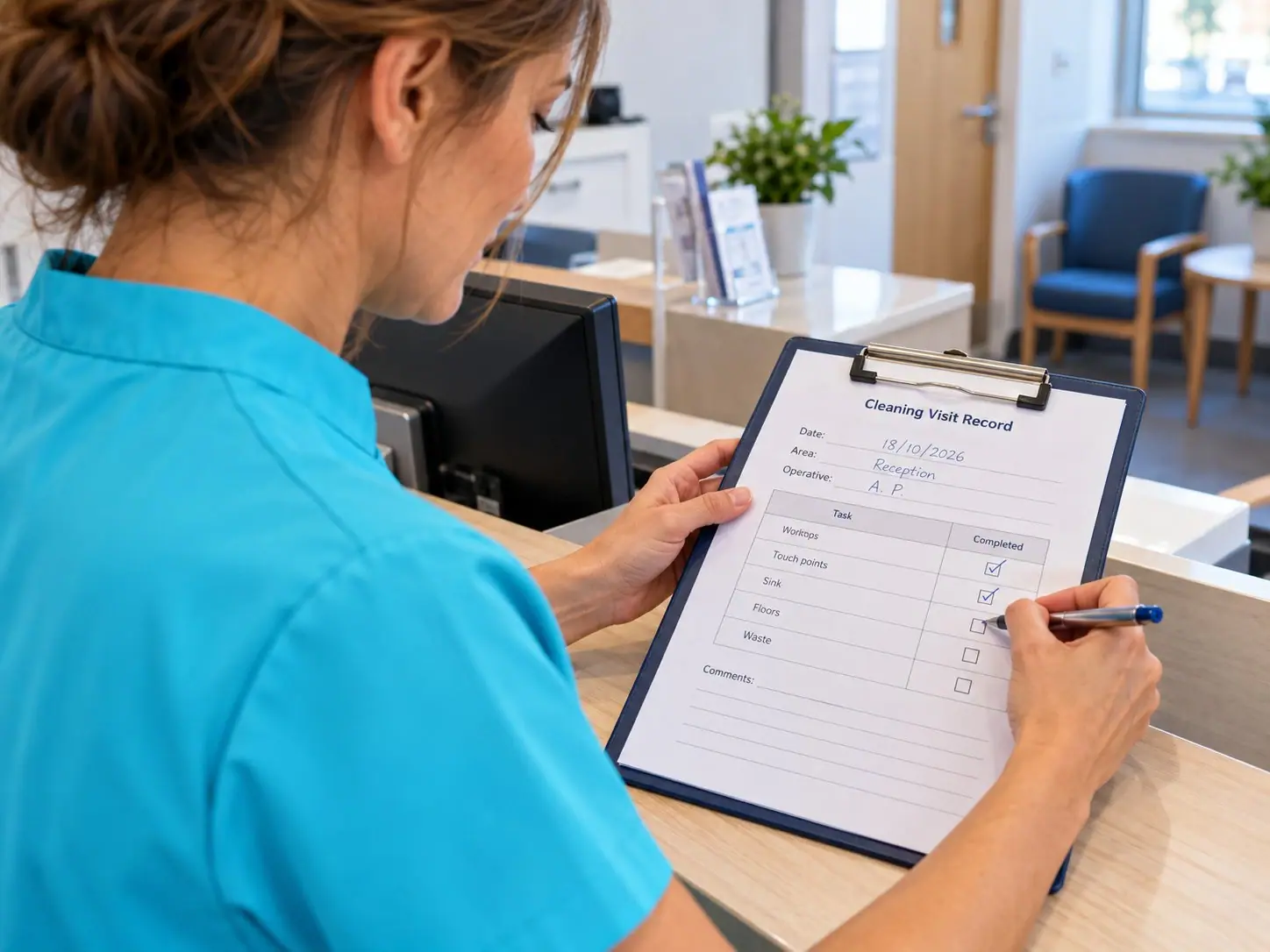
| A completed checklist does not list individual tasks | A signature shows that someone attended. It does not show which surfaces were cleaned, so a missed task is hard to trace. | Ask for records that list tasks by room, with the date and the operative, and a way to report missed work. | Task-level records that someone senior checks against what they see in the rooms. |
| A visit is missed and there is no agreed escalation | The gap may go unnoticed until someone raises a concern, and nobody is sure who to call or how soon cover can arrive. | Agree before work starts who is told, how quickly, what cover or catch-up is offered and how it is recorded. | A written escalation and cover arrangement, and a record each time it is used. |
None of these needs a particular technology. They need clear wording in the specification and someone who checks it is being followed.
What should you look for when comparing two quotations?
Compare quotations against the same written requirements before comparing attendance hours or overall cost.
Use this checklist for each provider. Mark each item Included, Not included or Unclear, and request supporting detail where appropriate.
A checked box means only that the quotation addresses the requirement. It does not prove the provider’s competence or the quality of the work. Ask to see an example specification, redacted record or audit format where useful, and ensure the proposed schedule reflects your actual needs.
Quotation comparison worksheet
Compare two quotations against the same ten requirements. Nothing you enter is stored, sent or tracked.
- Use what each quotation states in writing, not what was said in conversation.
- Choose Unclear when the wording could be read in more than one way. It becomes a question to ask.
- Price is not part of this worksheet. Compare it once you know what each quotation covers.
Answers stay on this page and disappear when you leave or reset. A tick means the quotation addresses the requirement, not that the provider is competent.
Not sure what your cleaning specification should include?
If you would like to talk through a specification or a quotation you have received, we can look at it with you.
How should you read the claims in a quotation?
Treat a claim as the start of a question. Any provider should be able to explain what a phrase means for your site and how it can be shown.
| If a quotation says | Useful questions to ask |
|---|---|
| “Fully compliant” | Compliant with what, and who judged it? Compliance is assessed for the registered provider, so ask what the claim means in practice and what evidence supports it. |
| “Rigorous training” | What does the training cover and how long does it take? How is competence checked, and can you see a training record? |
| “Regular audits” | Who carries them out, how often, against what criteria? Are findings shared with you, and what happens to the actions? |
| “Specialist” or “infection control expertise” | What does this change in the rooms you have? Who is the named person, and what is their experience? |
| “Competitive” or “cost-effective” | Compared with what scope? Ask each provider to price the same written specification. |
| “Advanced technology” | What is it for, what evidence supports its use in your setting, and which physical cleaning tasks does it leave unchanged? |
A provider that answers these questions in writing, without hesitation, gives you something concrete to compare. Where an answer is vague, that is useful information too.
Why do training, cleaning records and audits matter?

Training, records and audits help an organisation manage cleaning as a continuing process instead of relying solely on individual visits.
Site-specific instruction should cover assigned tasks, cleaning sequences, appropriate equipment, product use, areas requiring special care and when to stop and escalate a concern. Signed records show that work was recorded as completed; they are not laboratory evidence that a surface is free of microorganisms.
Supervisory checks can identify missed tasks, visible cleanliness concerns and gaps in documentation. A useful audit records findings, allocates corrective actions and follows up whether they were resolved. The objective is not paperwork for its own sake, but a system you can review and improve.
What the records can and cannot demonstrate
They can show
- That a visit took place, and when
- That agreed tasks were recorded as completed, and by whom
- A trail you can check, query and audit
They cannot show
- That every surface was adequately cleaned
- That a surface is free of microorganisms, or that disinfection worked
- That your wider IPC arrangements are sufficient
What does regulator guidance say about cleaning?
CQC guidance expects GP practices to have suitable infection prevention and control arrangements, including cleaning schedules, defined responsibilities and an IPC audit programme.
The CQC’s GP mythbuster 99 identifies the need for an effective IPC policy and a lead person with overall responsibility. It says cleaning contractors should have schedules stating the frequency of cleaning for specific areas, fittings and frequently touched items, and that schedules should be checked regularly. It is written for GP practices, but it is a useful worked example for other settings.
For providers registered with CQC, Regulation 15 requires premises and equipment to be clean, suitable and properly used, with hygiene standards that suit how they are used. It does not mention cleaning contractors or set out particular schedules. Dental, care, fertility and veterinary services also have their own regulators or professional bodies, so check the guidance that applies to your registration.
The NHS National Standards of Healthcare Cleanliness 2025 are relevant to NHS trust settings and provide useful guidance for primary care, with application proportionate to the setting. CQC does not expect GP practices to display cleanliness star ratings. No cleaning provider can guarantee an inspection result: the organisation remains responsible for its wider IPC arrangements.
Why might two clinical cleaning quotations differ?
Two quotations may differ because the service includes different amounts of training, supervision, management, documentation, equipment and quality assurance.
Those activities take resources, including time outside the scheduled cleaning visit. A quotation that covers only attendance cannot fairly be compared hour for hour with one that also provides scheduled audits and formal reporting.
Equally, a higher quotation is not automatically better. The real test is whether the specification matches the site, the responsibilities are practical, and the promised checks and reporting are included in the agreement. This is particularly important for GP practice cleaning and other healthcare environments.
Where do scientific methods and additional technologies fit?
Science should guide the selection of cleaning and disinfection methods; it should not become a reason to introduce unnecessary equipment or products.
Hypochlorous acid (HOCl) may have a role where a particular product is appropriately authorised, supported for the intended application and compatible with surfaces and equipment. Automated dry fogging can be considered only as an adjunct where a site-specific assessment justifies its use and the appropriate exposure, access and compatibility controls are in place.
Neither replaces physical cleaning. Nor should fogging be presented as a routine requirement for GP, dental, aesthetic or care settings. The appropriate method follows from the clinical environment and its IPC procedures, not from the technology a contractor happens to offer.
What should you do next?
Start with the specification, then assess whether each provider can deliver and document it.
Review your rooms, agreed cleaning frequencies, responsibilities for clinical equipment, training arrangements, records and approach to escalation. Give the same requirements to all companies quoting. If anything is unclear, ask for the proposed method and evidence rather than relying on a general assurance that the premises will be kept clean.
For related environments, see sectors supported by Aridom Sanex.
Request a Clinical Cleaning Assessment
An assessment can help define which environmental cleaning tasks belong in your service specification and how the work will be managed.
Aridom Sanex is based in Maidstone and works across Kent and Medway, with London and the South East by arrangement. Our proposed specification-led clinical cleaning service is built around trained operatives, written tasks, signed records for each visit and scheduled checks shared with your designated lead. Availability and the exact service scope are confirmed for each contract.
Frequently asked questions
What is the difference between clinical cleaning and general cleaning?
Clinical cleaning follows procedures matched to the healthcare environment, its activities and contamination risks. General cleaning is appropriate for many office and reception functions. The difference is not simply the company name or cleaning product. It lies in the specification, responsibilities, staff competence, agreed checking arrangements and records of completed work.
Does a healthcare setting need a specialist cleaning company?
CQC guidance does not require GP practices to appoint a contractor with a particular specialist label, and the same principle is a sensible starting point elsewhere. Cleaning can be completed by trained employees or an external provider. What matters is a suitable cleaning schedule, clear responsibilities, effective IPC oversight and evidence that agreed work is carried out and reviewed. Check any specific expectations of your own regulator or professional body.
What should a clinical cleaning schedule include?
A cleaning schedule should identify the areas, fixtures and fittings to be cleaned, with appropriate frequencies. Frequently touched items such as switches, door handles and telephones need explicit consideration. It should also make clear who is responsible for the tasks and how the organisation checks that the arrangements are being followed.
Are cleaning audits expected in healthcare settings?
CQC’s GP guidance expects an IPC audit programme and evidence of how identified issues have been addressed. It also expects cleaning contractors’ schedules to be checked regularly for compliance. Other settings should check the guidance that applies to them. Contractor checks may contribute useful evidence but cannot replace your own IPC governance.
Who cleans clinical equipment in a dental, GP or care setting?
The responsibility depends on the equipment, the activity and your approved procedures. Certain patient-care equipment must remain the responsibility of trained clinical staff. A contractor may clean agreed environmental surfaces, but the schedule should clearly exclude tasks outside its competence or contract. Manufacturer instructions and IPC policies must take priority.
Do signed cleaning sheets prove that a clinic is safe?
No. A signed sheet is a record that specified work was marked as completed, not proof that every surface was adequately cleaned or disinfected. Useful assurance also depends on training, observation, supervision, audits and prompt correction of problems. Records should support practical oversight, not replace it.
Can HOCl or automated dry fogging replace manual cleaning?
No. Physical cleaning remains an essential part of environmental hygiene. A suitable HOCl product or an automated dry fogging process may have a role in particular circumstances, but only after assessment of the intended use, evidence, authorisation, compatibility and safety controls. Neither should be presented as a replacement for routine cleaning.
How can I compare clinical cleaning quotes fairly?
Provide every supplier with the same room list, cleaning tasks, frequencies and responsibilities. Compare what each quotation says about training, cleaning records, audits, reporting and handling problems. Ask for clarification where commitments are unclear. The service specification is a better basis for comparison than the quoted attendance hours alone.
What is the difference between routine cleaning and a deep clean?
Routine cleaning delivers agreed tasks on a regular schedule. A periodic deep clean is a planned, more intensive clean of surfaces and areas that routine visits do not reach. One does not replace the other, so a specification should say which is included, how often deep cleans are planned and who confirms they are complete.
Does a cleaning contract usually include clinical waste and sharps?
Not necessarily. Clinical waste and sharps are normally handled under separate arrangements with their own legal requirements. A specification should say plainly whether they are included, and you should not assume that a cleaning provider will handle them.
Guidance and sources
- Care Quality Commission: GP mythbuster 99, Infection prevention and control in General Practice
- Care Quality Commission: Regulation 15, Premises and equipment
- NHS England: National Standards of Healthcare Cleanliness 2025
- British Medical Association: How to prepare for a CQC inspection
This article is general information and does not replace advice from your infection prevention and control lead.