

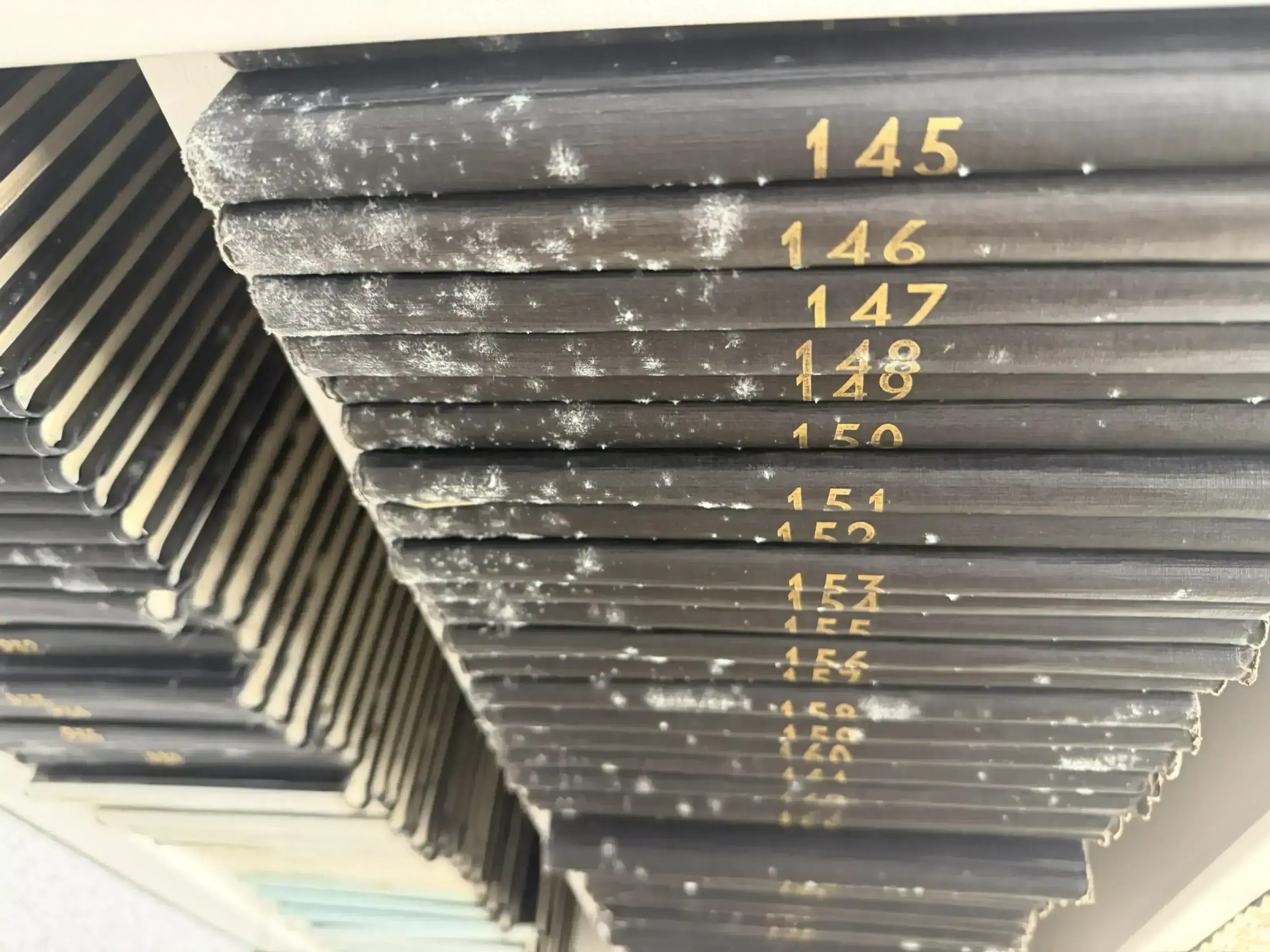
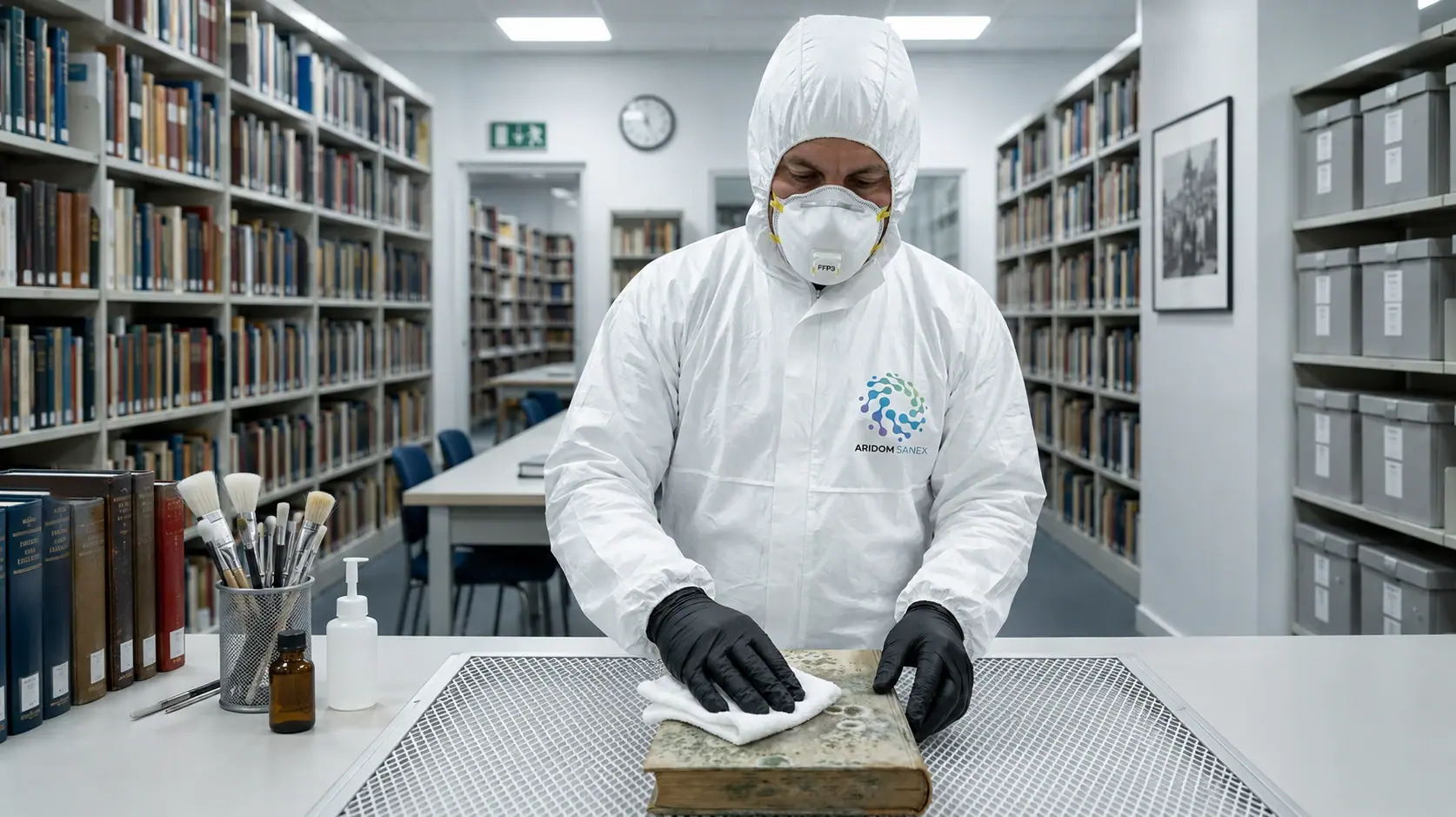
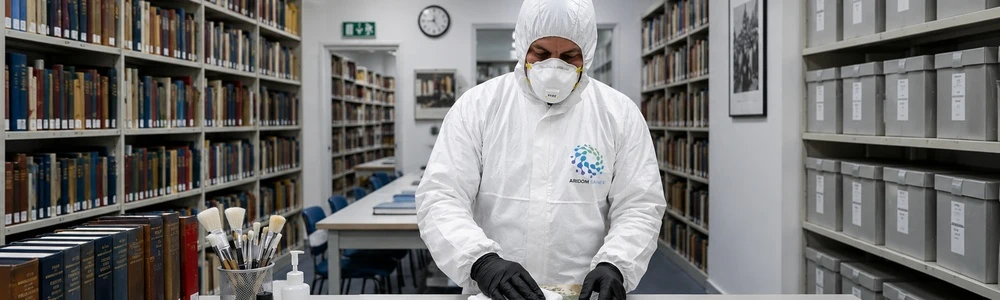
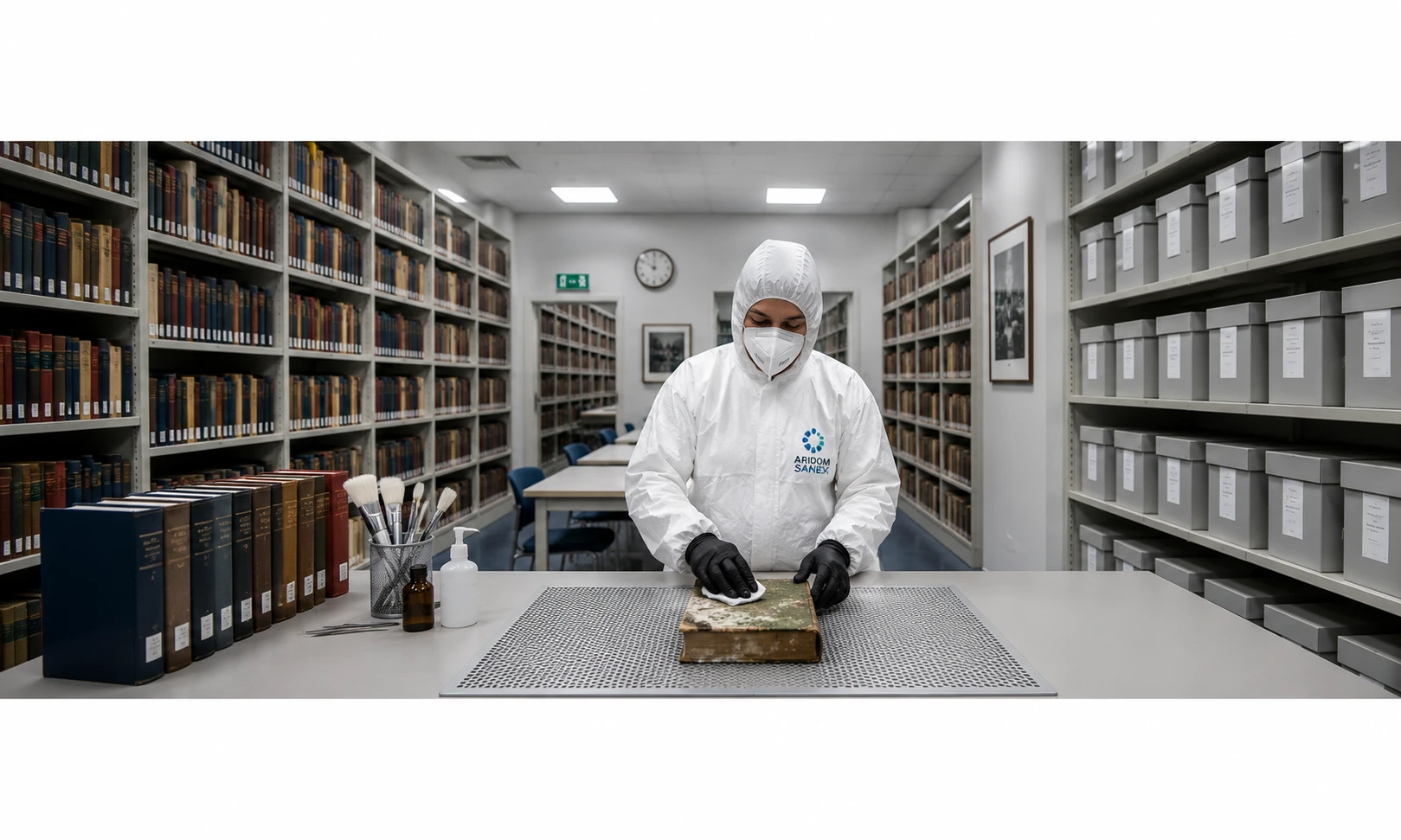
Mould in an archive, library, museum or heritage building is not simply a cleaning problem. It is a preservation risk, an environmental risk and, in many cases, an operational risk.
Historic documents, rare books, manuscripts, civic records, photographs, leather bindings, parchment and paper-based collections can be highly vulnerable to moisture, fungal growth and inappropriate chemical treatment. When mould appears in these environments, the response must do more than remove visible contamination. It must protect the collection, reduce risk to staff, avoid unnecessary damage to sensitive materials and help prevent recurrence.
Aridom Sanex is a UK specialist provider of preservation-focused mould remediation and environmental hygiene services for archives, libraries, museums, heritage buildings, government repositories and public sector estates. Our work combines safer chemistry, HOCl-based decontamination, HEPA filtration, dry fogging, environmental risk assessment and practical remediation methodology.
Why mould in archives requires a specialist approach
Archive mould is different from ordinary building mould because the affected materials are often irreplaceable.
In a standard commercial building, the main priority may be to treat walls, ceilings, flooring or ventilation areas. In an archive or heritage setting, the affected environment may contain paper records, bound volumes, leather covers, historic registers, photographs, textiles or mixed conservation-sensitive materials.
Mould contamination in these settings is commonly linked to:
- Fluctuating temperature and relative humidity
- Water ingress
- Rising damp
- Poor ventilation
- Condensation
- Inadequate air movement
- Storage systems placed close to cold or damp surfaces
- Historic moisture exposure within older buildings
Once mould becomes established, spores can spread through the air and settle across shelves, covers, bindings, walls, floors and hidden voids. Surface cleaning alone may not be enough if the underlying moisture source is not assessed and addressed.
The risks of generic mould treatment in heritage environments
Generic mould removal methods are not always suitable for archive, library or museum environments.
Harsh chemical treatments, excessive moisture, uncontrolled spraying or aggressive cleaning methods can create secondary risks, including:
- Damage to paper, card, cloth, leather or parchment
- Discolouration or staining
- Residual chemical contamination
- Increased moisture exposure
- Disruption to access and operations
- Incomplete treatment of hidden areas
- Failure to address ventilation, humidity or structural causes
For archive managers, conservators, facilities managers and procurement teams, the question is not simply whether mould can be removed. The real question is whether the intervention protects the collection, staff, building and future access to the records.
Aridom Sanex’s preservation-focused remediation method
Aridom Sanex approaches archive and heritage mould remediation as a controlled environmental risk intervention.
Our methodology may include:
- Initial site assessment and risk review
- Identification of likely moisture, humidity and ventilation drivers
- Protection of sensitive materials during treatment
- HEPA filtration to reduce airborne spore burden
- Careful surface treatment where appropriate
- HOCl-based safer chemistry
- Automated dry fogging for environmental decontamination
- Practical recommendations to reduce recurrence risk
- Post-treatment reporting and evidence for internal records, estates teams or procurement files
The objective is not only to treat the visible mould. The objective is to support preservation, reduce biological risk and help the organisation make informed decisions about recurrence prevention.
HOCl dry fogging, HEPA filtration and controlled intervention
Aridom Sanex uses hypochlorous acid, known as HOCl, as part of its safer chemistry approach. HOCl is an effective oxidising biocide used for microbial risk reduction and environmental hygiene applications.
In suitable environments, HOCl can be applied through controlled methods including dry fogging. Dry fogging allows fine aerosol distribution across surfaces and hard-to-reach spaces, supporting environmental decontamination without relying on heavy wetting.
One of the major advantages of this approach is that, in many archive environments, treatment can be carried out without removing the entire collection from the storage area. Alternative remediation methods often require every affected item to be individually removed, catalogued, tracked, transported and stored elsewhere before treatment can begin.
For archives and libraries containing thousands of books, files or historic records, this can become a significant project in its own right. Each item may need to be recorded before leaving the building, its location documented, chain-of-custody maintained and its condition monitored throughout handling and transportation. This process can introduce additional risks to fragile materials while dramatically increasing labour requirements, project duration and overall cost.
In some cases, organisations may need to arrange temporary storage facilities, suspend access to collections for extended periods or allocate internal staff resources to support inventory management and retrieval. What initially appears to be a mould remediation project can quickly become a complex collection relocation exercise.
By reducing the need for large-scale removal of archive materials wherever appropriate, a preservation-focused remediation strategy can help minimise disruption, maintain collection integrity, reduce handling risks and support faster return to normal operations.
For archive and heritage settings, control is critical. Treatment must be planned around the condition of the collection, the building, the type of material affected, the severity of contamination and the risk of moisture exposure.
Protecting collections, staff and operational continuity
Mould in archive and heritage environments can affect more than the collection itself. It may also affect staff confidence, public access, operational continuity and the organisation’s duty to manage environmental risk.
For public sector repositories, local authorities, universities, museums and historic estates, delayed intervention can lead to:
- Further deterioration of records or collections
- Extended closure of storage or public access areas
- Increased remediation costs
- Staff concerns about exposure
- Reputational risk
- Procurement and compliance pressure
- Recurrence if the underlying cause is not addressed
A preservation-focused remediation plan helps decision makers move from emergency reaction to controlled risk management.
Supporting archives, libraries, museums and government repositories
Aridom Sanex supports organisations responsible for sensitive, high-value or irreplaceable assets, including:
- Local authority archives
- County record offices
- University archives
- Museums
- Historic houses
- Libraries
- Government repositories
- Public sector storage facilities
- Heritage buildings
- Facilities management providers supporting specialist clients
We can work directly with the asset owner or as a specialist subcontractor to a facilities management company where archive-specific mould remediation expertise is required.
What a good archive mould remediation plan should include
A credible archive mould remediation plan should consider both treatment and prevention.
Key elements include:
- Clear assessment of visible mould and affected zones
- Identification of likely moisture or ventilation causes
- Material-sensitive treatment methodology
- Avoidance of unnecessary wetting
- Suitable filtration and containment controls
- Appropriate safer chemistry selection
- Protection of staff and building users
- Evidence-led reporting
- Recommendations for humidity, ventilation and monitoring
- A plan to reduce recurrence risk
- An ongoing maintenance and inspection programme where building issues remain unresolved
This is especially important in older buildings where structural moisture, poor ventilation or hidden voids may continue to support mould growth if not addressed. In many heritage properties, remediation should be viewed as part of a wider building management strategy, with regular monitoring and maintenance continuing until all underlying building defects and environmental issues have been fully rectified.
When to request a confidential assessment
You should seek specialist advice if:
- Mould is visible on documents, books, registers, shelves or storage areas
- There is a persistent musty odour in an archive or repository
- Staff have raised concerns about air quality or mould exposure
- A leak, flood or humidity incident has affected collection storage
- Mould has returned after previous cleaning
- The affected area contains sensitive or irreplaceable material
- An FM provider requires specialist archive remediation support
- Procurement teams need a safer, evidence-led remediation approach
Early assessment is usually more effective than waiting until contamination spreads further through the collection or building.
Request a confidential archive mould assessment
If you manage an archive, library, museum, heritage building or public sector repository affected by mould, Aridom Sanex can provide a confidential assessment and preservation-focused remediation plan.
We support organisations that need to protect sensitive collections, reduce environmental risk, maintain operational continuity and move away from hazardous or unsuitable chemical approaches.
Contact Aridom Sanex to discuss archive mould remediation, heritage mould treatment, HOCl dry fogging or specialist subcontractor support for facilities management providers.
Contact us today to discuss archive mould remediation and heritage collection protection.